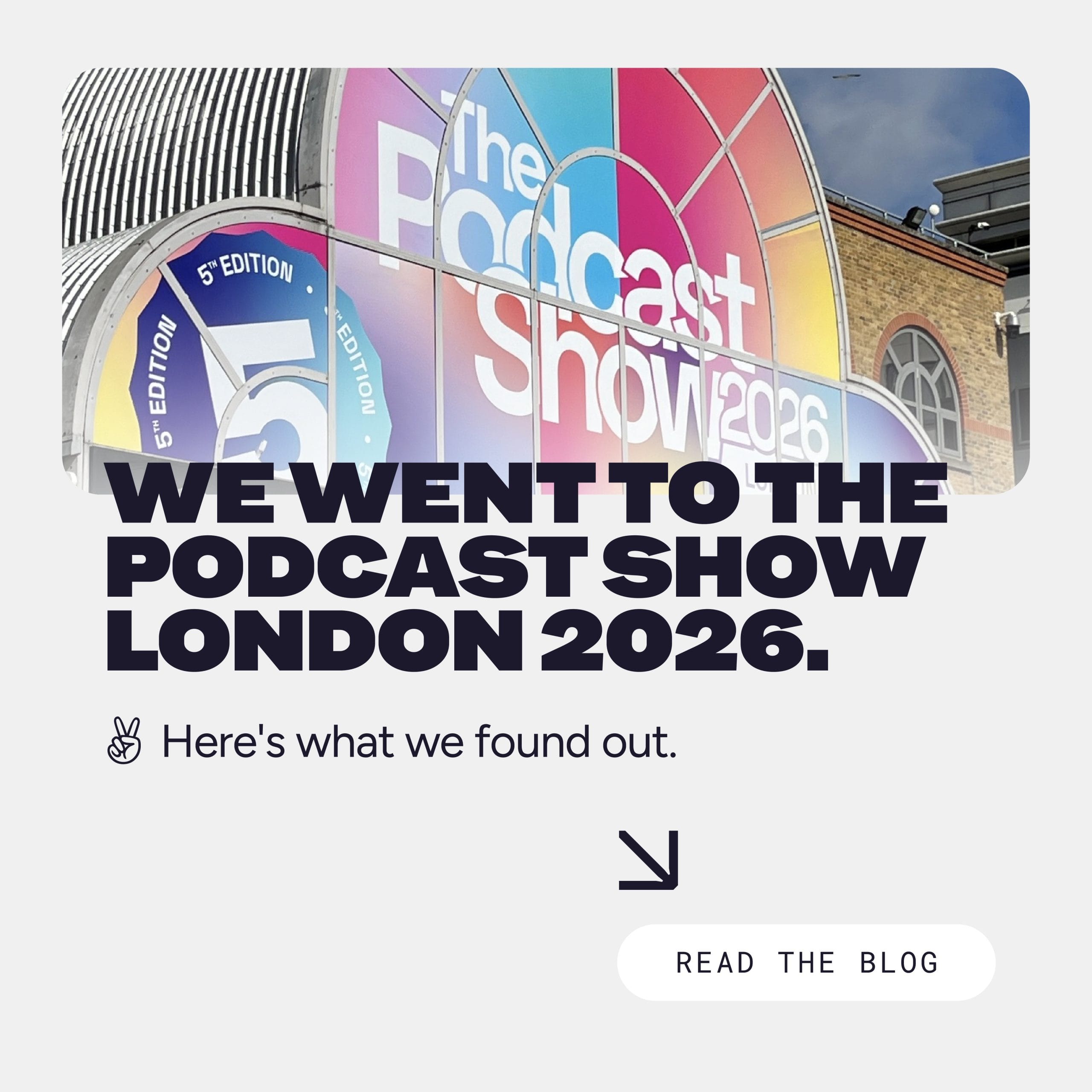
The Podcast Show London 2026 landed at the Business Design Centre on 20th and 21st May, and if there was one thing the room agreed on, it’s that podcasting is no longer the scrappy underdog of the media world.
Creators, broadcasters, advertisers, technology providers and communications professionals descended from around the world to talk about where the industry is heading. And the answer, broadly, is everywhere. What started as people talking into microphones in spare bedrooms has grown into a multi-platform ecosystem that’s attracting serious attention, serious money and some pretty serious talent.
But for all the talk of video, AI and new revenue models, the thing that kept coming up was way simpler than any of that. The podcasts people love are still the ones with something worth saying and someone worth listening to. No one’s wasting their time listening to over-processed corporate waffle in their spare time.
Here are ten of the biggest takeaways from the show and what they mean for creators, and brands alike.
1. Get the camera out… or should we say in?
If you’re still thinking of your podcast as purely an audio experience, the show had a fairly clear message for you. It’s time to catch up.
That’s because video has become the primary discovery engine for podcast content, with audiences increasingly encountering clips on YouTube, LinkedIn, TikTok and Instagram before they ever commit to a full episode – or even know who the podcaster is. YouTube has now overtaken Spotify as the go-to platform for vodcasts, which tells you everything you need to know about where audience behaviour is heading. Especially considering YouTube, at one point, looked to be on the outs!
So, it seems the creators winning right now are the ones who walk into the studio thinking about both from the start. For brands and businesses, that shift opens up a pretty exciting opportunity to extend the life of podcast content through short-form clips and social highlights that do the hard work of bringing new audiences in.
2. AI is handy, but it’s not taking the mic
Sound familiar? Because this is exactly the conversation we were having at our Dead or Alive event with D&AD just a few weeks ago.
The consensus at the show was the same as the one our room landed on in Soho. AI works brilliantly when it’s in service of a good idea, and considerably less brilliantly when it’s asked to be the idea itself. Podcast teams are using it to generate transcripts, cut highlights, edit audio, translate content and repurpose long-form episodes into social assets – aka all the unglamorous stuff that used to eat into the time better spent on making the main thing good.
Sure, it’s not 100% there yet in quality – we’ve probably all seen a dodgy transcript or two recently, and there are a fair amount of consumers that are anti-AI too, but for those who don’t have a massive production budget behind them, it’s an incredibly powerful sidekick.
3. Your podcast might be worth more than you think
One of the more eye-opening threads running through the show was the conversation around intellectual property. Podcasts are no longer just podcasts. In fact, the successful ones are becoming fully fledged media properties with books, documentaries, live events, TV adaptations and branded experiences sitting behind them.
Just take a look at Olivia Attwood’s ‘Olivia’s House’, which is an impressive example of this in action. Built around 121 intimate interviews creating a space for smart, funny women to talk, it’s now expanding into live events and merchandise, and a whole lot more.
For anyone building a podcast with long-term ambitions, the message from the show was clear. Think early about ownership, licensing and where the content could go, because the creators who treat their podcast as a platform rather than a programme are the ones ending up with something really quite valuable.
4. Community is a powerhouse
You’re not going to believe it, but it turns out the most powerful thing a podcast can do has nothing to do with production quality or even posting schedules or platform algorithms.
It’s belonging.
The podcasts people are really obsessed with have built something that feels like a club worth joining. A shared point of view and a reason to come back that goes beyond the episode itself. And once that exists, it’s almost impossible for a competitor to replicate.
For brands, this is where it gets interesting. A podcast that gets your audience talking to each other rather than just listening to you is one of the most valuable things you can build. The loyalty that comes from it tends to stick around a lot longer than any campaign.
5. Podcasting is going global, fast
For a long time, podcasting was largely an English-speaking party. That’s changing at a pace that caught even some of the more seasoned voices at the show off guard.
Europe, Asia, Latin America, Africa and the Middle East are all seeing serious growth, and advances in AI-powered translation and localisation are making it a whole lot easier to reach audiences who would have been out of reach just a couple of years ago. The barriers are coming down and the opportunity on the other side of them is significant.
For organisations thinking about their content strategy, the question is less about whether to think internationally and more about how quickly you want to get there before everyone else does.
6. Consistency beats fireworks every time
The best quote from the whole show came from a simple observation. Podcasts are a campfire, not fireworks.
Dedicated listeners are creatures of habit. They show up expecting you to do the same, on the same day, at the same time, every week without fail. The podcasts that last are the ones that respect that relationship rather than chasing the quick win that fizzles out almost before it gets going.
Fireworks are spectacular for about thirty seconds. A campfire keeps people warm all night.
7. Great storytelling still wins
Somewhere between all the AI tools and revenue model discussions, the show kept coming back to something much more straightforward. Nobody sticks around for a boring story.
Jamie Laing was a highlight for a reason. His Jampot vodcast leans hard into humour and emotion to cut through a social feed absolutely drowning in podcast clips, and he’s been deliberate about making it visually distinct without losing what people already love about him. His take was refreshingly no-nonsense – give people something worth following across a series and they’ll follow it.
The tech can open the door, but the story has to do the rest.
8. Creators are taking centre stage
If you’ve been sleeping on independent creators, the show was a majorly loud wake up call.
The tools and distribution that used to be locked behind big media budgets are now available to anyone with a decent idea and the commitment to show up for it. And the audiences these creators have built are fiercely loyal, highly engaged and very hard to reach any other way.
Louise Burke from NetMums put it perfectly. Their partnership with JB Gill from JLS worked because it was built on shared trust rather than just reach. The content that landed with their audience was emotional and entertaining, and having a credible voice behind it made all the difference. Podcasting is personal in a way most media isn’t – listeners are inviting these people into their lives, from the daily commute to settling down before bed, so when a brand shows up in that space, it had better feel like it belongs there.
9. Networking central
Nobody puts it on the agenda, but everyone knows it’s true – some of the best things that happen at The Podcast Show happen nowhere near a stage.
Two days surrounded by the people actively shaping the future of podcasting has a funny way of turning into the most valuable time you’ll spend all year. More than a few attendees walked away with a contact who completely changed what they were planning to do next.
Get yourself in the room. You never know who’s standing next to you in the coffee queue.
10. Podcasting is part of the marketing mix
Right, gather round, because this one is important.
Shockingly, podcasting isn’t just for true crime obsessives and people who want to feel like they’re learning something on the bus anymore. In fact, it’s become a majorly powerful tool for internal communications, and the businesses waking up to that fact are already ahead of the curve.
You see, hearing a leading voice is a lot more powerful than a carefully worded company email. It’s more human, obviously, but its also far easier to engage with. Whether it’s a short monthly CEO update or even a session tackling real questions from the workforce, podcasting as part of your internal comms hits completely differently when people choose to listen to it on their commute rather than being guilted into reading it at their desk.
The L&D space is running with it too. Onboarding, leadership development, upskilling – audio fits around people’s days in a way that screen time rarely does, and that’s a very good reason to start taking it seriously.